Thursday, April 22, 2010

Gunung Kinabalu - Birds and "Monkey Cups"

For me, it seems to be an annual pilgrimage that saw us once again on our beloved mountain - Gunung Kinabalu.

Beloved for us, as it is one of the easiest accessible mountain which exceeded the 4,000 m mark from our tropical island

Last year, I was captivated by the moths, and this year I tried to do it differently by focusing on the birds and the pitcher plants.

At about 3,300 m (2nd Montane) near to a resting point, we were visited by this bird (Mountain Blackeye Chlorocharis emiliae). This bird prefers the cool of the mountain top, and will occasionally descend to the lower plain at the Kinabalu Park (about 1,500 m) if the weather is nice and cool. Otherwise, you have to climb to their habitat.


Another commonly sighted feather friend at the Kinabalu Park is this Chestnut Hooded Laughing Thrust (Rhinocichla treachery), it was early morning about 7 am, and it was feeding time. Near to our dorminotry was couple of fruiting trees that attracted many types of birds. This hungry and definitely not shy Laughing Thrust was just at my eye level feasting on the fruits.


Kinabalu is home to about 15 different species of Pitcher Plant (Nepenthes), and occasionally it is also called the Monkey Cup, as it has been observed that monkey drinks from it. The word Nepenthes comes from the Greek for “no sorrow”, referring to an ancient drug called nepenthe.

Nepenthes are carnivorous, and the pitcher serves as a death trap to many unsuspecting insects as well as other vertebrates. However, there is the Nepenthes lowii that even collect bird’s dropping, and thus the lid will not enclosed the pitcher opening (peristoma).

In this walk up to the summit, we came across 2 different species.

Nepenthes tentaculata

Saw this species in abundance at about 2,500 m just before the Mersilau Trial merged with the Summit Trial. The unique feature of N tentaculata is the “hairiness” of the pitcher plant that “hairs” are growing from the lid as well.


Nepenthes macrophylla

In almost the same location as N tentaculata, the N macrophylla which is slightly bigger than the N tentaculata also grows in abundance.


Acknowledgement

It would have been very difficult for me to identify the birds and nepenthes as I am not familiar to this habitat, but thanks to an elderly German couple whom I spotted having breakfast with birdwatching utensils (binocular and long lens on their camera) that I intruded into their mealtime to ask them to help me to ID the birds. They were most helpful, and even go into the trouble to dig out their reference book to assist me.

For the nepenthes, the climbing guide that we have engaged to climb with us was knowledgeable in the fauna to provide me with the ID.

Monday, November 23, 2009

Tanjong Piai - Largest Ramsar Site in the World

Taman Negara Johor - Tanjong Piai
This is the largest Ramsar Site in the world, this is being mentioned in the visitor information centre.

The Ramsar Treaty is a intergovernment agreement to protect wetland (fresh and sea water) to promote conservation as well as the wise use of such ecological site.

More information can be obtained from http://www.ramsar.org/

In this website is listed all the 159 signatories to this treaty, unfortunately I was not able to located Singapore among them.

Tanjong Piai is also the most southerly tip of Peninsular Malaysia, and is also known as Cape Piai, this is where the Strait of Malacca joins with the Strait of Johor.


Welcoming visitor to the entrance of the board walk, is a big growth of Sea Holly (Jeruju Putih Acanthus illicifollius). A plant that grow very well in the mangrove area, and more so when there are fresh water. The medicinal value of this plant is described on this vertical board.


In the park, there seem to be a marked absence of insects. There were flies, wasps but no constant whirring of cicada.

Came upon this pair of insect which I have seemed previously in another blog, these insects looked like they were sparring with "boxing gloves".

Blue Spotted Mudskippers (Boleophthalmus baddarti) abound in this area, notice the extra long dorsal fin - this is the male. When courting or showing aggression it will lift this dorsal fin.

On one of the Bruguiera root, was a juvenile Mangrove Pit Viper (Trimeresurus purpureomaculatus) resting or sunbathing. According to literature, this snake can be very unpredictable and is also very poisonous, however for today when this picture was taken, it was in a very lethargic mood!


We were fortunate to caught sight of the skittish and shy Mangrove Skink (Emoia atrocostata), and apparently they are not shy here, as we saw many of them, and some of them were so near to us. Unlike in Singapore, where a sighting of such a specimen would have been a rare occasion!


On the bark of many trees, we noticed white blotches and possibly lichen growing on the trunk, but what captivated me was the fungusgrowing on the bark. On close inspection - it was some kind of fungus with fuzzy ball.

It was definitely a great change and exposure coming here, though the organism here were very similar to back home, but somehow the behaviour, abundance and different setting give a very different perspective to the way we view these plants and animals.

Perhaps our own wetland authority can exchange a thing or two of ideas with Tanjong Piai National Park authority in the areas of conservation and wise use of our own wetland.

Wednesday, August 5, 2009

Snakes in Bukit Timah Nature Reserve (BTNR)


Snakes at BTNR

In my many years of trekking in BTNR, I have seen many snakes, but the problem is usually in recording that moment.

So far, with different equipment I have managed to capture 4 different snakes that I have chanced upon in BTNR.

I am not a snake expert, and will require much reading and research to ID and know these beautiful serpentines. Therefore if you can identify the unknown snakes and describe its behaviour or characteristics, it is much appreciated.

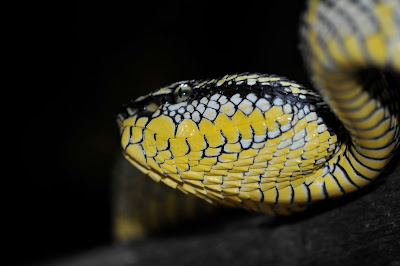
Wagler Pit Viper (Tropidolaemus wagleri)

Saw this snake up on a tree in Dairy Farm area. A nocturnal and arboreal snake, though poisonous the Wagler Pit Viper is a very docile snake.

I was able to go real close, and it simply coiled on the tree branch, letting me take all the shots.

Usually mistaken for another species of snake, the juvenile of the Wagler is green in colour, very unlike the adult.

Blue Coral Snake (Calliophis bivirgatus)

Another venomous snake and nocturnal, belonging to the elapid group - or sea snake. Usually feed on other snakes, even its own kind, but will feast on small amphibians and reptile if the chance should come around.

Came across this Coral Snake at the Forest Fall Walk, I was only armed with a phone camera. Resolution was bad, and evening has descended.

Unknown Snake 1

Came across this pretty long snake near to Rifle Range Road. It was actually sun-bathing in the morning on the bicycle track. Knowing that potentially it will be rolled over, I decided to hold it by its tail, and soon it slithered itself into the undergrowth.

From the body pattern, it seems to have two shade - a more solid colour at the tail area, as compared to the upper portion.

After performing the deed, I pondered whether this is a venomous snake!


Unknown Snake 2

Saw this snake just captured something - and has already swallowed its prey. It slowly slithered away from me at the Pipeline Reserve, but because of its meal, it wasn’t able to slither fast, and manage to capture number of shots on a compact camera.

Again, it was near to the bicycle track - and this time I have to use sticks to persuade it to move away from the track.

Again, is this a venomous snake!


Wednesday, July 1, 2009

Moths of Kinabalu

Moths - similar to Butterfly belongs to the Order of Lepidoptera (or Scaly Wings) belonging to the Class of Insecta.

Chief differences to the other insects are
a. Sex determination is via the ZW where the ovum determines the sex of the offspring.
(Unlike the XY Sex Determination where the sperm determines the sex of the offspring)
b. Dense setae (scales) on the wings. In other insects, the wings are usually transparent
/transclusent memberanes.
c. Multi hue and pattern on the wings. The scales itself form a type of light trap where light
frequency get adjusted. Thus the colours on the wings change as one shifts one's position
when looking at them.
d. Larvae of such insect has mouth structure and glands that can secrete silk.
Spider does it but through their abdomen.

There has been many misconception about moth - that it is dull and nocturnal. On the contrary - moths are as colourful as butterflies, if not more colourful!

For these collection of Moths that you are seeing, all are from Kinabalu National Park. Why Moths and not Butterflies, well for one thing - it was easier to photograph them than attempt to chase after butterflies. With the light on, they came in drove, and then happily settle on the wall, floor, doors etc. And with the temperature dropping at night, at 1,500 m, these creatures become very docile and even by placing the camera just 2 cm away from them, does not scoot them away! And secondly, there are more variation (Family) in moths than butterflies, and thus there are more shape and size.

Notice the numbers of moths just on a single wall!
Below are the pictures of moths taken in the morning, when the moths were still in "sleepy" stupor.

Unfortunately, my knowledge of moths are not good, and I can only identify one species (attacus Atlas) - the rest I hope you can help me to identify.

Atlas Moth (attacus Atlas)


Future shape of a Steath Aircraft!


Does this moth looks like a bee or beetle?


Monday, May 11, 2009

Yellowstone - Largest Volcano in the World

In the Visitor Education Centre in Canyon Village, immediately at the Reception area, this message greets the visitor.
“Yellowstone National Park is an immense, active volcano - one of the largest and most violent on earth”


But it is very hard to envisage that the Yellowstone National Park is sitting on top of a volcano, as there are no sign of crater or cauldron of magma. However, the geothermal activities in the form of geysers, fumarole, mudpot, hot spring and steam vent in Yellowstone indicate that there are underground volcanic activities.

There are many geothermal activities in countries like New Zealand, Japan, Iceland. But Yellowstone is one area that holds about 60% of all geysers around the world. The most famous and well known around the world is Old Faithful.

Scientists believed that in ancient time, a super volcano has erupted, and its magma chamber has collapsed forming a huge caldera - the size so huge that the country Singapore can be placed comfortably inside! The collapsed areas gave rise to the beautiful landscape of geothermal geysers with its beautiful colours, as well as the largest lake in US above 2000 m - the Yellowstone Lake.

The Yellowstone National Park is located on average of about 2,100 m and rivers flow down either to the Pacific or Atlantic sides. In this geothermal active zone, bedrocks plunged downward, with other places rising upwards forming the beautiful landscaped mountain ranges. Waterfalls are abundant here, and in one of the lower fall of the Yellowstone River, the rock face is Yellow in colour.

The wall acts like canvas to the Great Artist who created heaven and earth, allows the mineral to stain the wall face. Over time, the various chemical present in the water have stained the canyon walls with palette of Yellow, Pink, White and Red. But in this area, Yellow is most prevalent.


Yellowstone River - Lower Fall
Water flow through the canyon, surronded by Yellow Walls


The surface activities of the geothermal evidences produced many interesting patterns and colours in the various geyser basins.


In the geyser basin, the most famous geyser will be Old Faithful.

Old Faithful geyser - erupt on a regular basis. Geyser occurs when underground chamber contains water that has been boiled to superheated stage (high pressure with high temperature), and because of constriction in one of its chamber, the pressure continues to buildup to the point where the constriction cannot hold back the water, steam, and with a sudden release causes the water and steam to erupt.

Water is of turquose colour, resulted by the dissolved mineral. Mineral in the water calcified on the surface, and forms wall like terrace.


Volcanic activities are usually associated with toxic substance like sulphur, and in this landscape, rotten egg (Hydrogen Sulphide) is very obvious. The Hydrogen Sulphide rises from the magma, and is consumed by certain bacteria (called thermophiles) thrives in such mudpot, with the byproduct as sulphuric acid. The sulphuric acid “eats” up the rocks and solis, and turn them into mud. Amazingly, some mudpot acidity is so high, that it can easily burn the human skin.

Mudpot
Underground , the water chamber is ever shifting, due to seismic movement. What happen if death to some of the fauna which sheds its leaves and leaving behind a very bald appearance but with a very whitish appearance at the bottom of its trunk - as though it has just put on a white sock! Elsewhere, because of the diversion, suddenly the landscape becomes habitable, and plants started to take root and grow!

In this desolate plain, the ground movement has taken place, and instead of life giving water, the mineral filled water has flown into this area.
As a result, the trees in this area have died, and put on a white sock as shown at the base of the trunk. Look carefully, and you can see a lone coyote running in this desolate zone.

However, in area previously was the source of hot spring, the underground channel has shifted, and now grass is beginning to grow in this previously inhospital zone!

Panoramic view of the Hayden Valley.
Look carefully at the river, and you will notice that it is going round in bends.
In time to come, ox bow lake will be formed.

Yellowstone is a most amazing place. Scientists have determined that a major eruption is long overdue from this super-volcano. Much bigger than the Krakatoa in Indonesia. One that will envelope with ashes - turning day into night. One with the potential to split the continent into half.
Will that day come! While the seismic monitor continue to register the many quakes that occurs, and volcanologists continue in the guest to determine when it will happen.
To us, we will continue to enjoy the great scenery that Yellowstone provides.


Yellowstone River - Upper Fall
Yellowstone River - Lower Fall