Showing posts with label Nature. Show all posts

Wednesday, August 21, 2013

Admiralty Park & Sungei Cina

As part of the Heron Watch (population count) team, we were assigned Admiralty Park and Sungei Cina to perform the count on 31st Aug 2013.
As we were unfamiliar with that area, I decided to do a pre-watch survey "Heron Survey".

Heron and Egret - none.
Plenty of Javan Mynah; Yellow Vented Bulbul, Swallow, Olive Throated Sunbird, and occasional Black Nape Oriole

But some things held interest in me

Putat Sungei (Barringtonia racemosa)
A critical endangered plant in Singapore, and so glad that there are many of these plants in this park.
Hailed for its medicinal value by local people, for treating the symptom of chicken pox (relieving of itch), to sore throat, as this plant produce a toxin called saponin, which is concentrated in the seeds.


Saw these beautiful flowers on the ground.
Then these undeveloped flowers.

Closed Up of the yet to be budded flowers.


Hanging so pretty on the stalk.


And the fruits

These Nests

With just their beaks, the weaver birds can construct such beautiful nests.
Alas, I waited for hours, no birds were seen, and there seem to be no activities in the nests.


Nipa Palm - Attap Palm
(Nypa fruticans)
The palms were fruiting, and came upon this one with flowers and fruits.
The flowers remind me of the Anthurium!


Waterway - Polluted Sungei Cina
Maybe that is why there are no water fowls!

Seemingly idyllic, but flowing in this water way are trash!  Somehow this river is treated as a convenient disposal system!

Oil slick from upstream


When we attended the Heron Survey briefing, we were told that many places in Singapore have lost the heronry (breeding heron site), because of
  1. fogging (in the attempt to rid the mosquitoes, we also ended up ridding the good bugs and birds); remember the "good old day" of DDT, effective but cause much damage to the environment.
  2. encroachment and disturbance
  3. pollution to the waterway where they feed
and not too exactly sure what is keeping the herons, egrets and bitterns away!
Perhaps it is the disturbance as construction is going on to widen the track; smell of tar is very strong; or there is nothing in the river to feed these water fowls, as the water is also polluted.

Going to do another survey - and this time hopefully can see herons.

Tuesday, August 20, 2013

Bukit Timah Cycling Trail - Improvement but at a cost!

After the original posting was done, I was contacted by NPark Officer to clarify the situation that I have observed,  I do appreciate the prompt response, and the explanations that have been given. The explanation and clarification, was about the safety of the users of the trail.  As most of us may know, occasionally there will be incidents involving the hikers and cyclists on common trail (like this one), and NPark has decided to create a new route solely for cyclists. 

This old trail will be used by hikers; and a new cycling trail will be created.  However, the choke point will still be at the bridge.  By then, the cycling trail will be on level ground instead of slope, and thus and hopefully, the cyclist speed would have slowed down.
In the process of creating this new cycling trail, I was told that NPark and the contractor have already surveyed the ground; and those trees that have been fell were dead, and to prevent it from uprooting or crashing unexpectedly, they were fell.  Further, I was also told that stringent measures have been taken to ensure that

  • the wheel barrow that is being used cannot be wider than the track
  • saplings that are removed will have to be replanted
  • trails that are created for the ease of construction will have to be returned to their former condition

Though I appreciate such measures being taken, however as a frequent hikers in this area, I wish that more appropriate action can be taken as I have seen the forest degrading.  For the past 7/8 years, I have seen 

  • many trees uprooted; 
  • erosion of the ground leading to exposed roots; 
  • newer trails to circumvent fallen obstacles and the unusual high steps.
  • more and more "sun seeking" ferns flourishing in areas that trees have fell

Going back to the original post that started this discourse; the forest can recover, but at its own recovery speed, and we (NPark and users of the reserve) can assist, if we
  • do not create unnecessary trails
  • do not cut down trees, though safety reason can be cited, but then this is a reserve, and not a park. He who enters the reserve, must know the risks, for beside falling branches there are also poisonous scorpions and snakes! 
  • be vigilant to ensure minimal damage is done in the name of "improvement"
  • be transparent to the reason for closed trail (to the public, Tiup Tiup path is always closed; and the last communication to the public via the newspaper was a landslide in that area, but that was many years ago!)

From the Dairy Farm Road, leading to Wallace Centre, there is this signboard that said "Cycling Trail being improved"

But a mould of dirt block the common passage, thus forcing trekkers and cyclists alike to form new trial to circumvent this obstruction! New trail means new "dead" zone!  This is an example of convenience for the contractor, but at the expense of the forest. Here I wish the NPark will educate the contractor to be more considerate.

The actual cycling trail is lower from where this worker in purple was going, but this is a short cut from the mould of dirt to the working site.  Again, it may be convenient, but a new trail has been created. I would opt for the usage of the cylcing trail even if I have to travel a few metres more!

This is the actual cycling trail.  The fell trees as mentioned were dead before they were fell.


It used to be dark, and that is what a rain forest should be, but with fallen trees - the canopy has a big gap, and in the tree's place, pioneer species will sprout, and soon it will be fern and softwood tree!

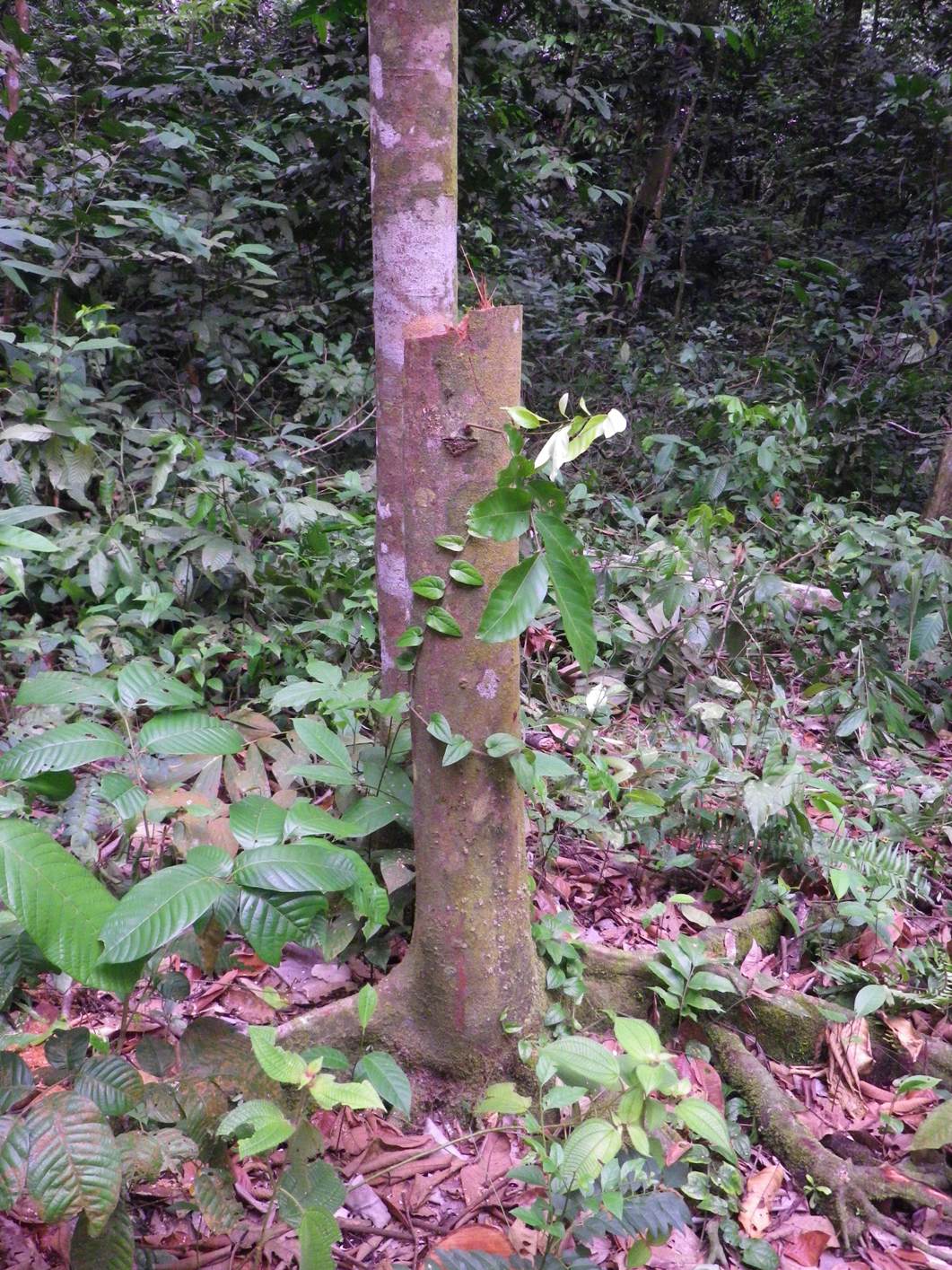
This tree is healthy and located opposite the cycling trail.  It is not dead, for leaves are seen sprouting from the stump. Though the explanation (not confirm) is that the trunk may have snapped, and thus it was cut.
I would like to thank all readers who have stopped by to read and browse, and hopefully this posting has brought much awareness for all.  We are all living on a small island, and there are economics reason as well as recreation that need to be balanced.
We all have to do our parts, if we are to pass down this natural heritage to our future generations.


Monday, September 10, 2012

Pacific Swallow

Pacific Swallow (Hirundo tahitica)

A very common swallow found in Singapore, a passerine bird unlike its closed cousin the swift or swiftlet.
And like swiflets, they are fantastic flyers catching insects and eating them in the air.
One notable difference between this swallow and swift, is that they can fly low, and as the picture shows, really low and at times come to rest on the road!

Following pictures taken in Dairy Farm (Singapore)

A very agile flyer, manipulating its wings to provide maximum maneuverability while in flight.  At this angle, the wings are asymmetrical, as it banked towards the right!

Shots were taken very near to the ground, as insects will congregate at lower elevation during a cold front, without the heat to bring them aloft.

With the wings fold back, there is reduction in drag, and thus increase in speed.

Most birds fly near to the ground to take advantage of the "low ground effect", being near to the ground, the amount of air below is sufficient to support the bird without much effort.  This is the same principle used in some plane that flies very near to the water level, but with much smaller wings!

A docile bird on a tarmac, either getting a rest or simply enjoying the heat on this cool morning.

Following pictures were taken in Senai (Johore)
Taken in Senai, this individual was guarding its nest while perching on a pole.


The nest is build from mud and twigs.  A form of madhouse formed this abode for this pair and its young's.


Bako National Park - Nature Reserve

Bako National Park (Sarawak)
Located near Kuching in Sarawak (Borneo), this is a 27 square kilometre of nature reserve.
Geological wise, it is made up of sandstone, and the occasional slates that will come hand in hand in such strata.
Sandstone - soft and easily carved by wind and water, produced many shapes and myriads of colours on the various surfaces, as well as free standing rock formations along the coastal areas.

Going to Bako requires a ride on a fast boat along the Sarawak river, and depending on the tide, it is either a wade in from far off shore, or fortunately for us, a jetty.
The coastal plain has a very low gradient, which means that at low tide, the water edge is very far from the shoreline, and during high tide, the water is not very deep.
Being of such low gradient, the tidal area tends to be sandy and devoid of coral reefs, but plenty of crabs build their burrows here.

We arrived at Bako National Park, and waited for our turn to disembark from the crowded jetty. 
Reaching the jetty, we came across this sea-stack (eroded formation of the sandstone), where the feature of this rock is aptly called the "Turtle Head", well some prefer to call it "Eagle Head".  My personal name will be Garuda, the mythical man--bird of Indonesia!

Mangrove is supposed to thrive in the inter-tidal area, but this mangroves seem to have faced difficult time and have perished, forming an eerie silhouette, but still home to small fishes in its roots system.

Welcoming us to Bako, is this Sign.


Another view of the jetty during low tide.

Across Bako is this island.  Formation wise, it reminded me of Kota Kinabalu in Sabah, albeit shorter!

We walked s short trial, Teluk Pandan Kechil, and a the end of this trial, we were up on a cliff looking down on this outcrop.

And on this cliff, we can see the evidence of erosion.  Apparently, the top part of the rock surface is made of harder substrate, but not the body, thus forming these mushroom shapes strata.


The eroded surface of an outcrop, with beautiful rocky colour and patterns.


Close-up of the sandstone wall, which can easily passed off as a modern art to be hung in some gallery!

A lone fig tree, surviving the harsh condition on this rock, with poor nutrient for sustenance, and still able to cling on.

Sea-Stack - formation of a raised cobra! Hmmmm... 

And this one - Bust of a Man looking out to sea.
Well, the formation of the rocks and strata, does give one plenty of time to relax and wonder in our imagination to come up with some nice names.

Fiddling and Hermit Crabs on the Mudflat Shores

An electric blue Fiddler, one that I have seen in one of the offshore island in Singapore. As the big claw is on the right, lets called this the right handed one.
And this is a leftie!

Probably the female of the Electric Blue Fiddler.  Notice the two smaller cousins on the lower right.

Being one a right handed, and a leftie, there is good reason to fight, as the sparring  claws are just in the right place!

But with two lefties, well, it is going to be a bit tough.


Ghost Crab, superb runner on the sandy beach.  It took number of us to be able to catch one of this crab. And still it was not easy.


Mollusk and Insects

A Beautiful Sun-dial, that somehow has the colour and pattern of the rocky face!

A very beautiful iridescence beetle, the green simply escaped the sensor of my camera.  Unfortunately this beetle was dead.
The under-belly was even more colourful and iridescent.
The forest was filled with the filing noise of the Cicada, and on this tree, an empty case of a pupae, with its occupant happily making noises up the tree.
Damsel on a twine.


With wood comes termite, and the common perception of White Ant (Termite), well this picture showed that termites comes in black, busy carrying food and mud to its nest.


Night Critters
At night, Bako National Park proves to be equally active as in the day time.  However, we were out looking for critters and chance upon them.  Unfortunately, the sensor on my camera was not able to capture the beautiful lighting display by the Firefly.

Small Scorpion, very well camouflage and would have been missed if not for a UV light that we were carrying, that make it glow, as shown in the picture below.


Juvenile centipede.
Avian Kinds
Bako is famous for the birds, and we yearned to see Hornbill, but sadly that was the case, but other species indeed we get to see.


Common Iora

Magpie

Wall Swallow, but not a swallow.

Another view of the swallow

Little Tern was busy in the morning - hunting by diving into the water to catch fish for its broods.

busy busy - for the hungry chicks appetite never seem to fill!


And another fish ...

Mammalian Kinds
3 species of monkeys we will get to see in Bako, the Long Tail Macaque, which are plentiful.
Then the shy Silver Langur Monkey near the shore.
The unique one will be the monkey with a large nose, the Proboscis Monkey (Nasalis larvatus), and a recent documentary show of monkey in China (Yunnan) will be the other extreme, the Snubbed Nose Monkey (genus Rhinopithecus- without a nose!

Silver Langur Monkey

Male Proboscis Monkey - Nasalis larvatus
Being a leaf eater, it has a big tummy with all the bacteria  to aid in the digestion, it looks like one bloated monkey, having a bad colic. 

Female Proboscis Monkey - the nose tends to be smaller and cuter.  Not the male with the enlarged nose.

I was below this male when it decided to use the branches as a highway to another tree.

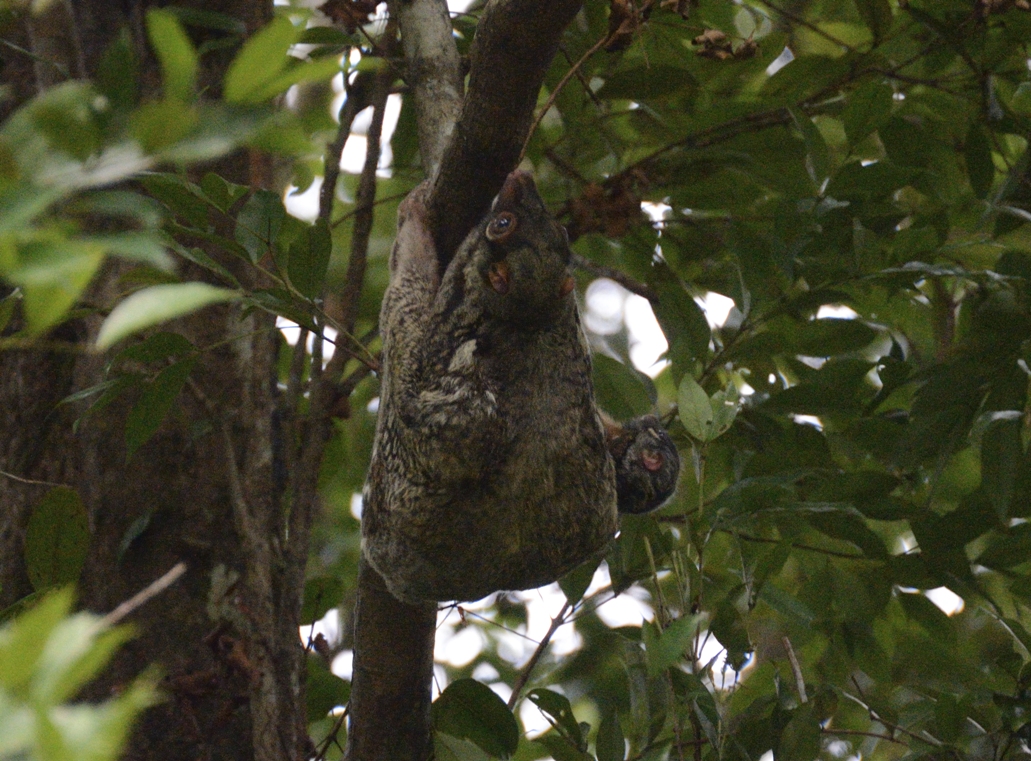
A Mama Colugo with its charge (Geopterus variegatus)

A family of bearded wild pig foraging for food in the mud flat.  Unfortunately, being big in size and no natural predators, these pigs have outgrown its ecological balance and causing much harm to the surrounding landscape with its ways of furrowing into the soil looking just about anything to eat.  In its track, will be uprooted grass patches, dead tress and muddy and soggy ground.
Plantae
As mentioned, with low level of useful loam, plants that grow here will have different method of survival.

Pitted pattern on these substrate, indicate the erosion via water, and eventually with enough water and strength, the erosion will produce the mushroom shapes strata seen earlier in this blog.

Sandstone route, on the side will be very poor soil for the plant.
Plants here have ingenious method of survival.  Insect eaters like these Nepenthes, or the small beautiful Morning Dew (Drosera spatulata)

Drosera spatulata, look closely at the spatula shaped leaf with glob of glues at the end of its hairy like structure.
This picture is composed of 5 pictures stacked together as the depth of fields in macro is not good enough to cover from the flowers to the leaves.


And for other plant, there is the parasitic mistletoe.  Growing and drawing nutrient from its victims, and at the same time with the capability to photosynthesis, even when the host plant died, the mistletoe will still survive.


Came across this tree which was blooming at its trunk, and interestingly - saw the same plant in Bukit Timah.

Taken at Bukit Timah (Singapore)

Close up of the flowers.

Taken at Bako!

Wild Durian


Hand holding hand!  After the rain, the water still being held between two twines.

Epiphyte - fern, taking advantage of its host, settled nicely up on the branch.

Closed up of the spores packet.


Reptilian Order


Skink

Wagler Pit Viper (Tropidolaemus wagleri)