Unusual for September, we are seeing more than the usual rainfall.
Coral Fungi (Family Clavariaceae)
Such fungi was thus name, as it looks like the "marine corals", and it even have different colour for its tips.
But from these pictures, it looks more like marine sponge than coral
These "dancing pair" was found in a common path, and not too sure how long it will last.


Tooth Fungi (Family Hydnaceae)
From the top or even from the side, it looks like a typical mushroom with a flat top and stalk, but look closely at the underside, and you will notice spines instead of the common gills like shape found in most of our edible mushrooms.
This is supposed to be pretty common on the forest floor, but one seldom peek below the basidiocarp (the cap) to have better appreciation of this species.
Some species of the tooth fungi grows in reverse, that is the spine is pointing upward, and not on the underside. Yet to see such a species.
Suspect that this is Hydnum rapandum.
And with couple of days of rain, it will be soggy ground and damp rotten wood. Ideal for fungi to sprout!
Manage to capture a number of the fungi, and most of them I have no clue to their IDs, except for very generic Order or Family names.
Such fungi was thus name, as it looks like the "marine corals", and it even have different colour for its tips.
But from these pictures, it looks more like marine sponge than coral
These "dancing pair" was found in a common path, and not too sure how long it will last.

 |
| From this angle, you can see there are 2 stalks that rose from the substrate, as though frozen in an body bending dance! |
 |
| This is a top view, and now it looks like a marine sponge! With inlets and outlets typical of sponge. |
 |
| From the dead trunk, more of this fungi was starting to propagate. |
 |
| Slightly bigger than the one shown immediately above, starting to branch. |

Tooth Fungi (Family Hydnaceae)
From the top or even from the side, it looks like a typical mushroom with a flat top and stalk, but look closely at the underside, and you will notice spines instead of the common gills like shape found in most of our edible mushrooms.
This is supposed to be pretty common on the forest floor, but one seldom peek below the basidiocarp (the cap) to have better appreciation of this species.
Some species of the tooth fungi grows in reverse, that is the spine is pointing upward, and not on the underside. Yet to see such a species.
 |
| From the plan view, unless one has good eyesight, one will not notice the spiny underside. |
 |
| Actually the spines are quite an impressive sight. |
Bracket and Split Gill (Schizophyllaceae) and Polyporaceae
And then there are the unique underside of the Split Gill and the Polyporaceae which looks also like the bracket mushroom.
 |
| Split Gill? I am not too sure. |
 |
| Like the Bracket Mushroom that grows from the side, same as these Polyporaceae |
Bracket Mushroom?
Afternote - A week later, I was at the same spot, and one of this specimen has toppled over.


 |
| Bracket Mushroom (Ganodermataceae)? |
 |
| Cannot discern the gill properly, and will not kill it just to have a better shot. |
Providing me an opportunity to take a closed-up of its gills.
 |
| the gills does not radiate from the centre, but somehow interlaced with one another to form a type of maze! |
Not too sure what is this type of mushroom, the gills structure is pitted, and looks like the same family as the above mushroom!


Assortment of Agaricales
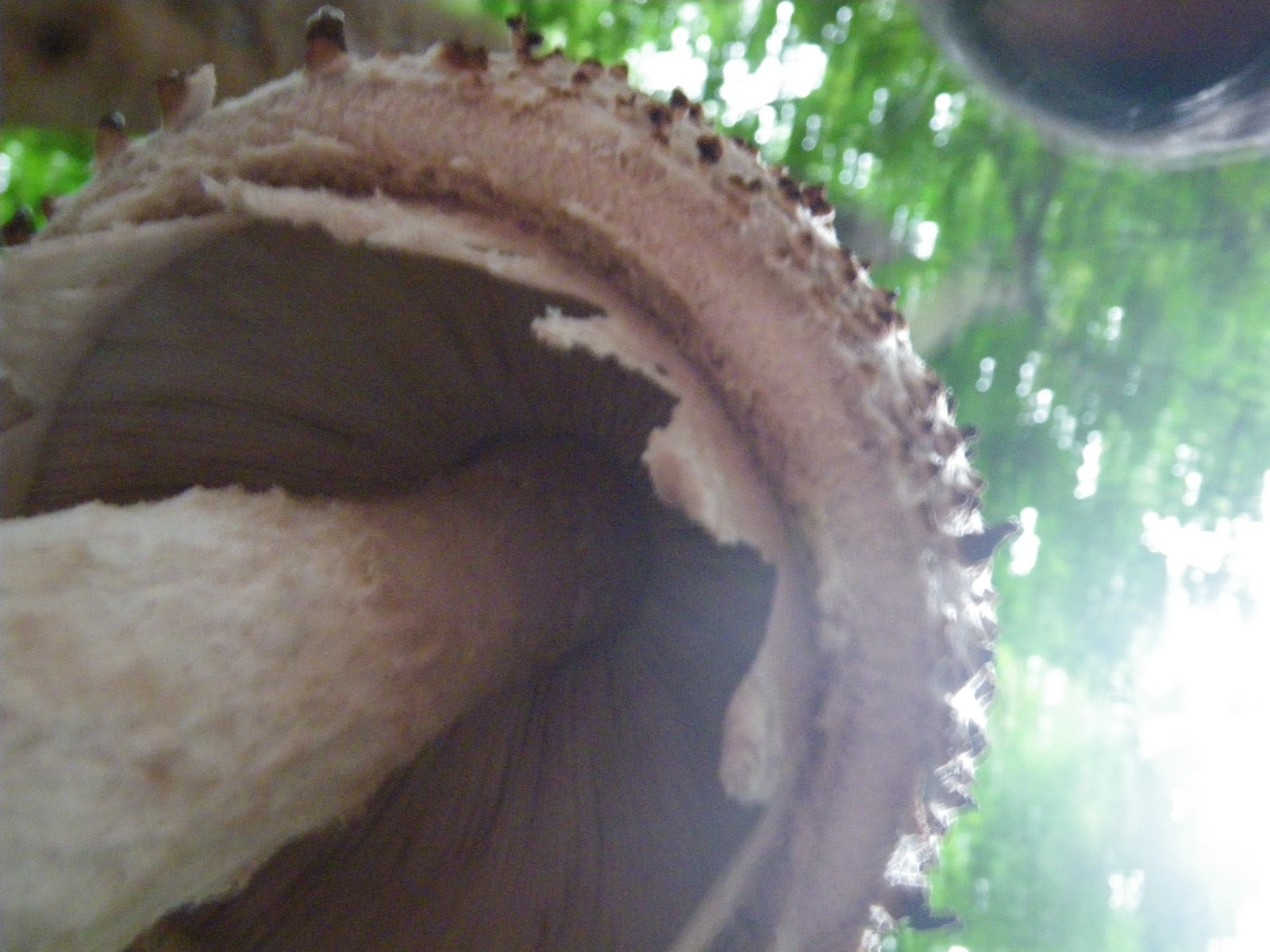
Why is it called Agaricales? Because of the gills under the cap.
And the gills can come in many patterns as seen in the pictures below, however the typical Agarcales gills radiate from the centre of the stalk (this can be observed when you are eating your mushrooms)


Why is it called Agaricales? Because of the gills under the cap.
And the gills can come in many patterns as seen in the pictures below, however the typical Agarcales gills radiate from the centre of the stalk (this can be observed when you are eating your mushrooms)
 |
| This will be the typical gill pattern that we are quite familiar. |
 |
| Looking like bottle caps |
 |
| The gills are are quite distinct in this picture. |

 |
| Another type of pattern for the gill. |


 |
| A very common Agaricus, the Amanita, and in my other blog, can grow to be a giant http://mountain-n-sea.blogspot.sg/2010/12/gigantic-agaricus.html. |

 |